Electromagnetic Neuromodulation
02 How It Works?
Modulating Neural Activity Along the Visual Pathway
Neuromodulation refers to the modulation of neural activity through the application of an external stimulus. Depending on the stimulation method, neural structures can be influenced through electrical, magnetic, chemical, or other physical mechanisms.
MagnoVision™ uses controlled, repetitive electromagnetic stimulation as part of its approach to the visual system.
Rather than considering the eye as an isolated structure, the system is designed around the functional visual pathway extending from the retina and optic nerve toward the visual cortex.
From an Electromagnetic Field to Neural Modulation
The fundamental principle behind electromagnetic neuromodulation is based on the interaction between a time-varying magnetic field and electrically conductive biological tissue.
When an electromagnetic field changes over time, it can induce an electric field within nearby conductive tissue. This physical principle provides the basis for non-invasive electromagnetic interaction with excitable biological structures.
The process can be simplified into four stages:
Electromagnetic Field → Induced Electrical Effects → Neural Interaction → Modulation of Neural Activity
01 — Generation of the Electromagnetic Field
03 — Interaction with Neural Membranes
Neurons communicate through changes in membrane potential and the controlled movement of ions across their cell membranes.
Ion channels and membrane proteins play a fundamental role in regulating this electrical activity.
Electromagnetically induced electrical effects may interact with these excitable structures and influence membrane activity and neuronal signaling.
This is the central concept of electromagnetic neuromodulation: the objective is not simply to deliver energy to tissue, but to interact with the electrophysiological processes involved in neural communication.
02 — Induction of Electrical Effects in Tissue
A changing magnetic field can generate an electric field within conductive biological tissues through the principle of electromagnetic induction.
Neural tissue contains electrically active cells whose function depends on electrochemical gradients across their cell membranes.
When the externally generated electromagnetic field interacts with these tissues, the resulting induced electrical effects may influence the electrical environment surrounding excitable neural structures.
Importantly, the magnetic field itself does not need to physically contact a neuron or deliver electrical current through an implanted electrode. Instead, electrical effects are generated within conductive tissue as a consequence of the changing electromagnetic field.
The Visual Pathway
Vision is not produced by the eye alone.
Visual information originates in the retina and is subsequently transmitted through a complex neural network before being processed by the brain.
A simplified representation of this pathway is:
Retina → Optic Nerve → Visual Cortex
Each of these structures performs a different role within visual processing.
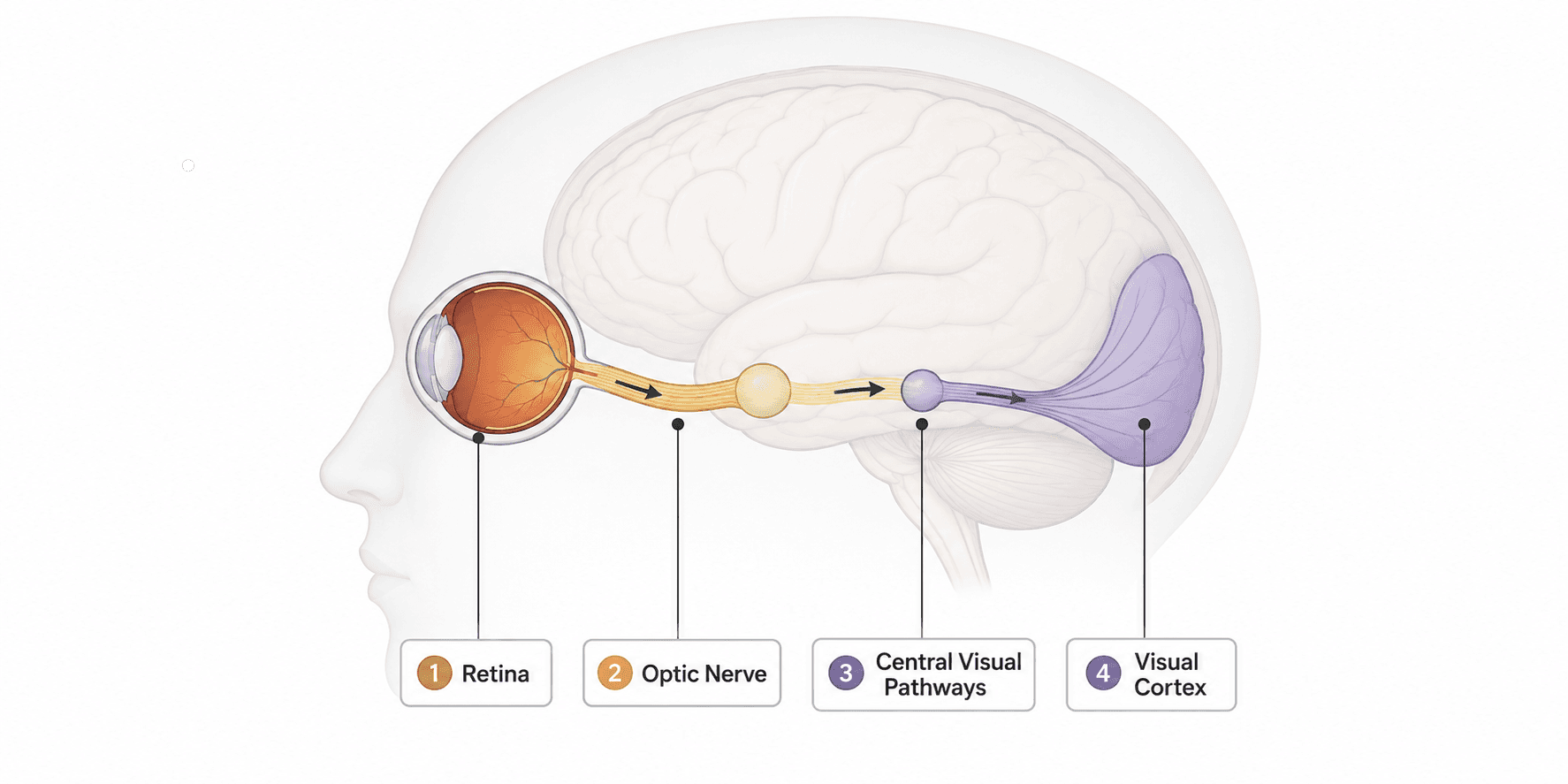
The operating concept of electromagnetic neuromodulation can ultimately be understood as a sequence connecting fundamental physics with neural physiology:
Time-varying electromagnetic field
↓
Electromagnetic induction
↓
Electrical effects within conductive biological tissue
↓
Interaction with electrically excitable neural structures
↓
Modulation of neural activity
↓
Visual pathway
This interaction between electromagnetic physics and neurophysiology forms one of the fundamental technological principles behind MagnoVision™.
Retina
The retina is a highly specialized neural tissue located at the posterior part of the eye.
Photoreceptors detect incoming light and initiate the conversion of optical information into electrical signals. These signals are subsequently processed through retinal neural networks before being transmitted by retinal ganglion cells.
The axons of retinal ganglion cells converge to form the optic nerve, establishing the connection between the retina and the central visual pathways.
Optic Nerve
The optic nerve represents the major neural connection carrying visual information from the retina toward the brain.
Because the optic nerve consists primarily of retinal ganglion cell axons, its function is directly dependent on the integrity and electrophysiological activity of these neural structures.
Visual information continues through the optic pathways toward higher-order processing regions of the brain.
Visual Cortex
The visual cortex, located primarily within the occipital region of the brain, is responsible for cortical processing of visual information.
Signals originating from the retina are transmitted through the visual pathway before reaching cortical networks, where information relating to form, orientation, movement, contrast, spatial relationships and other visual characteristics is processed.
The visual system should therefore be considered a connected neural pathway rather than a collection of independent anatomical structures.
A Visual-Pathway-Oriented Approach
This concept is central to the design philosophy of MagnoVision™.
The system incorporates nine electromagnetic coils, positioned around anterior and posterior regions of the head.
4 anterior coils are positioned in relation to the anterior visual structures, including the retinal and optic nerve regions.
5 posterior coils are positioned toward the posterior head and occipital region associated with cortical visual processing.
This arrangement allows the system to approach electromagnetic stimulation across different anatomical levels associated with the visual pathway.
Why 42 Hz?
MagnoVision™ delivers repetitive sinusoidal electromagnetic stimulation at 42 Hz.
Frequency is an important parameter in neuromodulation because neural systems operate through dynamic electrical activity and oscillatory patterns.
Rather than applying a static magnetic field, the system generates a repetitive time-varying electromagnetic stimulus. The changing field is essential because electromagnetic induction depends on variation of the magnetic field over time.
The stimulation frequency therefore determines the temporal pattern at which the electromagnetic field is repeatedly generated during a session.
In MagnoVision™, this stimulation is delivered according to the device's predefined operating parameters through its microprocessor-controlled system.
Controlled and Non-Invasive Stimulation
One of the important characteristics of electromagnetic neuromodulation is that stimulation can be delivered without surgical access to neural tissue.
MagnoVision™ does not require implanted electrodes or direct electrical connections to neural structures.
The stimulation parameters are generated and managed by the device's control system to provide repeatable operation throughout the session.
A standard MagnoVision™ session lasts 30 minutes, during which the system delivers repetitive electromagnetic stimulation according to its predefined parameters.
Key Parameters
42 Hz
Repetitive sinusoidal electromagnetic stimulation
9 Electromagnetic Coils
4 anterior + 5 posterior
30 Minutes
Standard session duration
Non-invasive
No implanted stimulation electrodes
From Physics to Neurobiology